
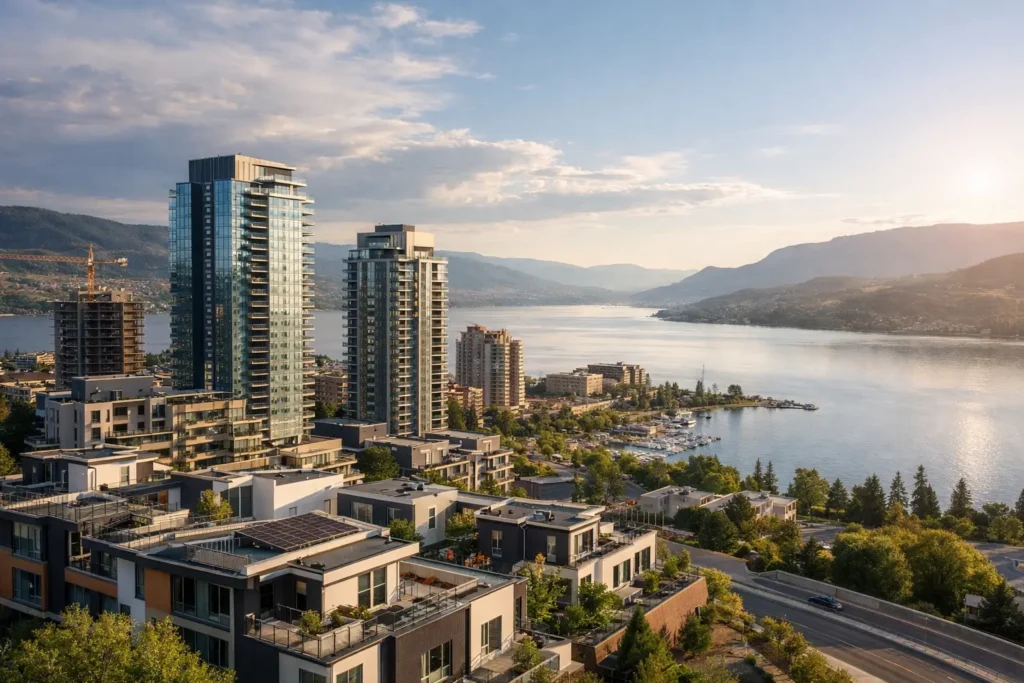
Kelowna’s housing story is no longer just about finding a home near the lake. It is about how people want to live: closer to work, schools, recreation, family, transit, and the everyday conveniences that make a neighbourhood feel right. The future of Kelowna housing will be shaped by that balance, along with population growth, new construction, affordability pressures, and the need to protect the lifestyle that brings people to the Okanagan in the first place.
For buyers and sellers, the most useful question is not whether the market will change. It will. The better question is how those changes may affect the kind of property, location, and timing that makes sense for your own plans.
More Housing, in More Forms
Kelowna is expected to continue adding housing, but much of that supply will look different from the detached homes that have long defined many Okanagan neighbourhoods. Condominiums, townhomes, purpose-built rentals, suites, and smaller multi-unit homes are likely to play a larger role as land becomes more expensive and communities work to accommodate more residents.
That does not mean single-family homes will lose their appeal. A well-kept home with outdoor space, a functional layout, and access to schools or parks will continue to be meaningful to families and move-up buyers. But the premium attached to a large lot may increasingly depend on location, redevelopment potential, privacy, and how well the home fits modern lifestyles.
For first-time buyers, townhomes and condos may remain the most realistic path into ownership. These homes can offer a lower entry price, less exterior maintenance, and locations closer to restaurants, employment areas, and the waterfront. The trade-off is strata fees, less private space, and the need to look closely at a building’s financial health, bylaws, and upcoming maintenance requirements.
For sellers, this shift creates a clear opportunity: presentation and positioning matter. A compact home that feels bright, organized, and easy to live in can compete very well when it is marketed to the right buyer. The value is not only in square footage. It is in the life a buyer can picture there.
The Future of Kelowna Housing Is Neighbourhood-Specific
Kelowna is not one uniform market, and future demand will not be spread evenly across the city. Buyers are increasingly comparing neighbourhoods based on daily routine rather than simply choosing the closest available property to downtown or the lake.
Urban-minded professionals may favour areas with walkability, dining, services, and a shorter commute. Families may place more weight on school catchments, yard space, recreation facilities, and quieter streets. Retirees may prefer a lock-and-leave condo, a rancher, or a community that keeps them close to golf, healthcare, and friends without requiring a large property to maintain.
This is also why surrounding communities will remain part of the conversation. Lake Country appeals to buyers seeking a more relaxed setting with access to Kelowna and Vernon. West Kelowna can offer lake views, established neighbourhoods, and a different pace across the bridge. Peachland continues to attract those drawn to a smaller waterfront community, while Vernon may suit buyers looking for a broader range of home styles and a different value equation.
The right choice depends on more than a map pin. Bridge traffic, commute patterns, slope and driveway maintenance, proximity to services, and even exposure to seasonal smoke can affect how a location feels in real life. Local guidance is especially valuable when two homes appear similar online but offer very different day-to-day experiences.
Affordability Will Keep Shaping Decisions
Affordability is likely to remain one of the strongest forces in the Kelowna market. Even when borrowing costs change, buyers still need to qualify, manage monthly expenses, and leave room in their budget for strata fees, property taxes, insurance, repairs, and the lifestyle they came here to enjoy.
As a result, many buyers will make more deliberate trade-offs. Some may choose a smaller home in a central location rather than a larger home farther out. Others may purchase with a legal suite or future suite potential to help offset costs. Some families may look beyond Kelowna proper to find more space, accepting a longer commute in return.
There is no universally better option. A downtown condo may be an excellent fit for someone who values walkability and low maintenance, while a home in a quieter area may make far more sense for a growing family. What matters is being honest about the costs and compromises that come with each choice.
Sellers should also recognize that buyers are calculating carefully. A home that needs significant updating may still attract attention, but its price needs to account for renovation costs, uncertainty, and the time required to complete the work. Properties that are clean, well maintained, and transparent about their condition often inspire greater confidence.
New Rules and Gentle Density Will Matter
Provincial housing changes and local planning decisions are encouraging more density in established areas. Over time, this may mean more secondary suites, carriage homes, duplexes, townhomes, and small multi-unit buildings in places where detached homes were once the only option.
For homeowners, this can create questions as well as possibilities. A property may have future redevelopment potential, but that does not automatically mean redevelopment is the best move or that it will be simple. Zoning, servicing, site conditions, financing, tenant arrangements, and construction costs all matter. Anyone considering a purchase based on development potential should look beyond a headline and understand the property’s specific circumstances.
For neighbours, more housing can bring change: additional traffic, construction activity, and evolving streetscapes. It can also bring practical benefits, including more options for adult children, downsizers, renters, and local workers who want to remain in the community. The most successful growth will be growth that adds homes while preserving the qualities people value, such as access to parks, local businesses, safe streets, and community connection.
Lifestyle Features Will Carry More Weight
The Okanagan lifestyle will remain a major driver of housing demand, but buyers are becoming more discerning about what that lifestyle actually requires. A lake view is appealing, yet so are shaded outdoor spaces, practical storage for bikes and skis, nearby trails, energy-efficient heating and cooling, and room for visiting family.
Climate considerations are also becoming part of the conversation. Buyers may ask about wildfire risk, insurance availability, landscaping, irrigation, sun exposure, and a home’s ability to stay comfortable during hot summers. These are not minor details. They can affect operating costs, peace of mind, and resale appeal.
Homes that are well cared for and adapted to local conditions may stand out. Features such as efficient windows, updated insulation, heat pumps, sensible drainage, and low-maintenance landscaping can be attractive because they support both comfort and predictable ownership costs. That said, upgrades do not all deliver the same return. A seller should focus first on improvements that make the home function better, show better, or remove a buyer concern.
What Buyers Should Do Now
Trying to predict the exact next move in the market can leave buyers waiting for perfect conditions that may never arrive. A more productive approach is to establish a realistic purchase range, understand the monthly carrying cost, and identify the few location and property features that are truly non-negotiable.
It also helps to look beyond the listing photos. Visit at different times of day when possible. Test the commute. Walk to the places you expect to use. Review strata documents carefully for condos and townhomes. If a suite is important to your plan, confirm that it is authorized and understand what is required to operate it appropriately.
The best purchase is not always the flashiest property. It is the home that supports your next chapter without stretching your finances or creating surprises you cannot comfortably manage.
What Sellers Should Do Now
Sellers do not need to renovate every room before listing, but they do need to understand how their home will be compared with others. Buyers will notice condition, layout, storage, outdoor usability, and location details quickly. They will also notice if a property is priced as though it has been fully updated when it has not.
A thoughtful selling strategy begins with a clear view of the likely buyer. Is your home best suited to a young couple, a family, a downsizer, an investor, or someone relocating to the Okanagan? The answer influences preparation, pricing, photography, and the story told around the property.
With nearly two decades of Okanagan market experience, Kathleen Stroeder understands that those details are rarely generic. A selling plan should reflect the street, the community, the season, and the buyer pool most likely to see value in your home.
Kelowna will continue to evolve, but the appeal of living in the Okanagan is not going away. Whether you are buying your first condo, selling a family home, or planning a move within the valley, a patient, local, and personal approach can help you make a decision that feels right long after the keys change hands.