
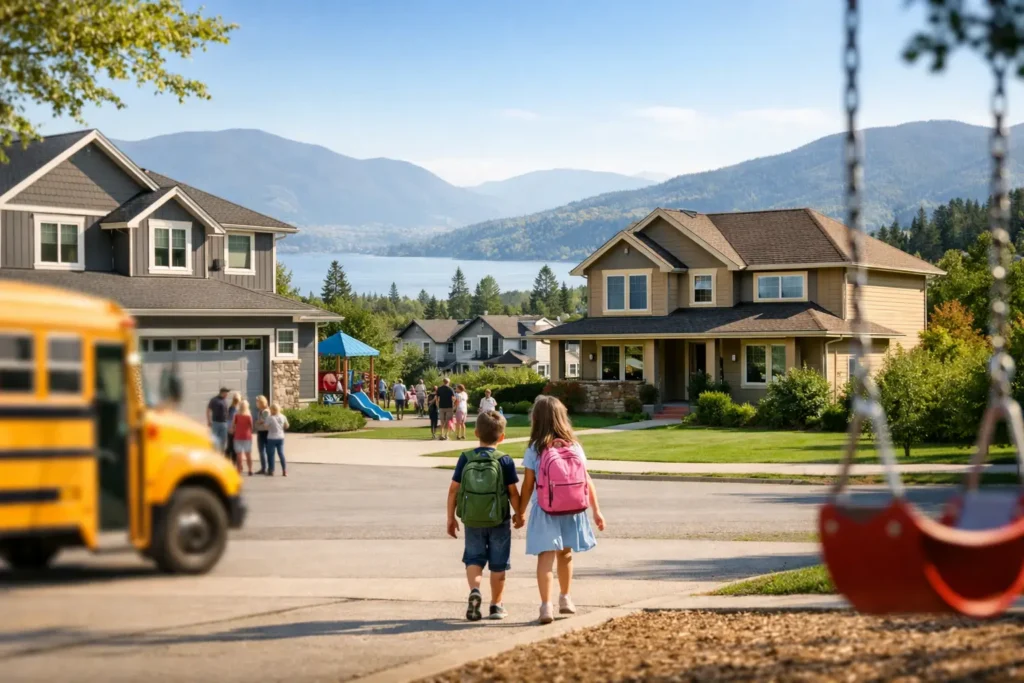
The morning routine can shape a home purchase more than buyers expect. For families considering Kelowna homes near schools, a shorter school run may mean calmer starts, more time outside after class, and a neighbourhood that feels connected to daily life. But proximity is only one part of the decision. The right fit also depends on catchment boundaries, walking routes, the type of home you need, and how the area will serve your family a few years from now.
Kelowna offers a wide range of school-adjacent communities, from established streets with mature trees to newer developments built around growing family needs. With the right local guidance, buyers can look beyond a map pin and choose a home that works for both their present routine and long-term plans.
Why Kelowna Homes Near Schools Appeal to Buyers
Living close to a school can offer practical benefits that are easy to appreciate once the school year is underway. Families may be able to walk, bike, or shorten their drive to drop-off and pickup. Children can build familiarity with their neighbourhood, and parents may find it easier to take part in school events, sports, and friendships close to home.
There is also a lifestyle component. Homes near parks, playgrounds, community centres, and schools often sit within neighbourhoods where families spend time outdoors and get to know one another. In Kelowna, that can mean an afternoon walk, a quick stop at a local beach or green space, or an easier connection to activities after school.
From a resale perspective, homes in established family-oriented areas can attract steady interest. That does not mean every property beside a school will command a premium, nor should a purchase be made on resale potential alone. It does mean that a well-kept home with a functional layout in a desirable school area may appeal to a broad pool of future buyers.
School Catchments Matter More Than Distance
One of the most common assumptions buyers make is that the nearest school is automatically the school their child can attend. In practice, school catchments and registration rules determine eligibility. A home may be only a few blocks from one school while falling within the boundary of another.
Before writing an offer, confirm the current catchment for the specific address and ask about the registration process. Boundaries, capacity, programs, and transportation arrangements can change, so it is wise to verify details directly with the appropriate school district rather than relying on an older listing description or a neighbour’s experience.
Some buyers are also looking for particular programs, such as French immersion, alternative learning options, or specialized supports. Those priorities can change the search area considerably. A home that is ideal for one family may not be the best choice for another if the preferred program is located across town.
Think Beyond Elementary Years
A location that feels perfect for kindergarten may need a second look when you consider middle and secondary school. Ask how your routine may evolve as children become more independent, participate in sports, or attend activities in different parts of Kelowna.
For younger families, it can be useful to consider bedroom count, yard space, storage, and the ability to work from home as well as the immediate school commute. For families with teens, transit access, recreation facilities, and routes to friends’ homes may become more relevant. Buying with a longer view does not require predicting every detail of family life. It simply helps prevent a very short-term decision.
Choose the Neighbourhood, Not Just the School
Kelowna’s family-friendly areas are varied, and each offers a different rhythm. Glenmore is often appealing to buyers who want access to amenities, parks, and central routes. Rutland provides a mix of established homes, services, and community connections, while the Lower Mission can attract buyers drawn to recreation, beaches, and an active outdoor lifestyle.
In newer or expanding areas such as Upper Mission, Wilden, and parts of North Glenmore, buyers may find contemporary homes, larger layouts, and neighbourhoods designed around trails and green space. These areas can be especially attractive when a family wants room to grow, although commute times and the distance to certain amenities deserve careful consideration.
There is no single best Kelowna neighbourhood for every household. A family with two working parents may prioritize an efficient route to work and childcare. Another may value a quiet cul-de-sac, a larger yard, or a walkable connection to school. The strongest search begins with an honest conversation about what daily life needs to look like.
Look Closely at the Route to School
A property can be technically close to a school but still be inconvenient to reach on foot. Major roads, steep grades, limited sidewalks, winter conditions, and busy intersections can all affect whether a route feels comfortable for a child.
When possible, visit at the times that matter. Drive the route during morning drop-off, walk the nearby streets, and notice parking pressure around the school. Kelowna neighbourhoods can feel very different during a quiet weekend showing than they do at 8:15 on a weekday morning.
Homes directly across from a school also involve a trade-off. The convenience can be excellent, but there may be more traffic, noise, parking activity, and foot traffic at the start and end of the day. Some buyers enjoy the energy and open views; others prefer to be a few blocks away, close enough to walk but removed from the busiest area.
Match the Home to Your Family’s Real Needs
A school-adjacent address does not compensate for a home that is too small, poorly laid out, or expensive to maintain. It helps to separate must-haves from nice-to-haves before touring properties.
For some buyers, a townhouse near school and amenities is the right balance of affordability and convenience. Others need a detached home with a fenced yard, extra bedrooms, and space for equipment, pets, or visiting family. Condo living can also work well for households that want less maintenance and a central location, provided the building rules, storage, and parking suit their lifestyle.
Be realistic about the whole cost of ownership. Property taxes, strata fees, insurance, utility costs, repairs, and potential renovations all affect what feels comfortable month to month. In a competitive market, it is easy to focus on getting an accepted offer. A clear budget helps ensure the home remains a positive decision after possession day.
Consider Flexibility in a Changing Market
If inventory is limited in your preferred catchment, deciding where to compromise can make the search more productive. You may choose a smaller home in a highly walkable area, or a larger home a short drive from school. You may also find value in a nearby community where the home style and neighbourhood feel better aligned with your priorities.
The key is to avoid treating one feature as the answer to everything. A great school location, for example, should still be paired with a home condition, price point, and commute that your household can sustain.
What Sellers Should Know About School-Area Buyers
If you are selling a home near a school, the story of the property should be specific and accurate. Buyers want to understand how the location supports daily life: nearby parks, sidewalks, transit, recreation, and the general feel of the neighbourhood. They also want honest information about traffic patterns and parking.
Thoughtful preparation can make a meaningful difference. A tidy entry, functional family spaces, organized storage, and a welcoming yard help buyers picture their own routine in the home. If your property is within a sought-after school catchment, that may be a valuable feature, but it should always be presented carefully. School assignment and program availability need to be verified by buyers through the proper sources.
Local pricing strategy matters as well. A home near a school is not priced in isolation. Its value is influenced by condition, lot size, updates, competing listings, street location, and buyer demand across the surrounding Kelowna community.
A well-chosen school-area home is not simply about saving minutes on a commute. It is about finding a place where mornings work, children can feel rooted, and the wider neighbourhood supports the life you want to build. Taking the time to compare streets, catchments, and home styles can turn a good address into the right long-term fit.